
Reading time: Approx. 3 minutes
Key Takeaways:
- Male hair loss is often linked to genetics and sensitivity to DHT, but stress, aging, and other factors can also play a role.
- That “I’ll just try another shampoo” phase? We get it. But hair loss usually starts beneath the surface, where shampoo can only do so much.
- The earlier you address thinning, the more options you may have to support healthier-looking hair.
- PRP Therapy uses concentrated platelets from your own blood to deliver growth factors to the scalp and support the hair follicles.
You first noticed it in a photo. Then you couldn’t unsee it.
Maybe it happened when you were getting ready for work.
You looked in the mirror, ran your hand through your hair, and thought: “Wait… has my hairline always looked like that?”
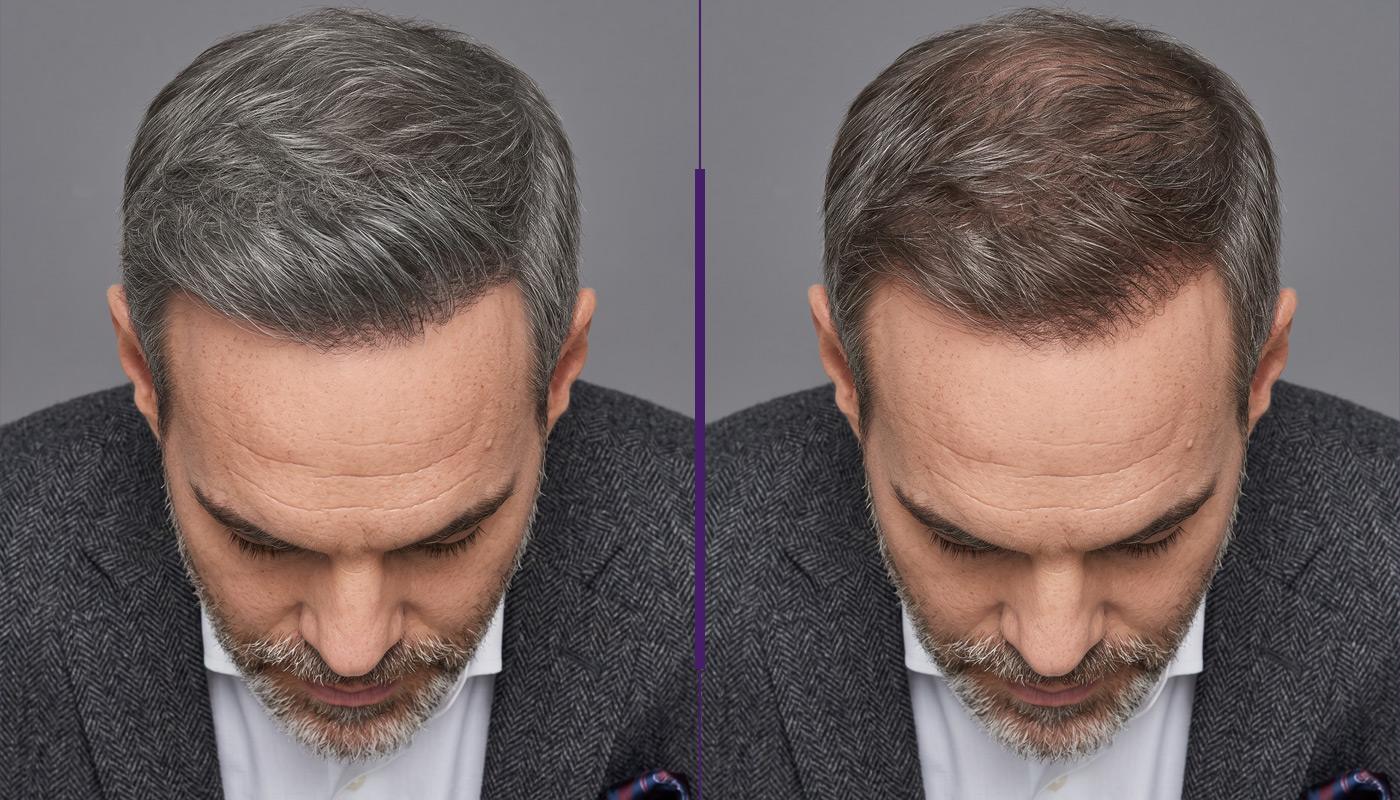
Or maybe it was a photo from a weekend in Windermere. You saw the top of your head from an angle you weren’t used to, and suddenly, that thinning spot at the crown wasn’t so easy to ignore.
For some men, it starts with a receding hairline. For others, it’s a little less volume on top, more hair in the shower drain, or having to style your hair differently just to make it look fuller.
And then comes the usual response:
“I’ll try a better shampoo.”
Then a supplement.
Then a foam.
Then another product promising “stronger, thicker hair.”
Sound familiar?
The problem isn’t that you’re not taking care of your hair. Hair loss isn’t a hygiene problem. In many cases, what’s happening is deeper than the hair you can see in the mirror.
So, what’s actually happening?
Male pattern hair loss doesn’t happen overnight. Your follicles gradually change over time, often influenced by genetics and their sensitivity to a hormone called DHT.
Think of it like this: the follicle doesn’t necessarily disappear right away. It can slowly start producing thinner, shorter hairs until what used to be a strong strand becomes barely noticeable.
A few things can contribute to that process:
- DHT sensitivity: Some men’s follicles are genetically more sensitive to DHT. Over time, this can cause them to shrink and produce progressively finer hairs.
- Changes in the scalp environment: As we age, circulation and the scalp’s ability to support healthy follicle activity can change. Stress and other lifestyle factors may also influence the hair-growth cycle.
- Follicular miniaturization: This is when a follicle gradually becomes smaller and produces thinner hair. What starts as “my hair just looks a little thinner” can eventually become much more noticeable.
And why does it seem to get worse all of a sudden?
Ask a guy who’s gone from his 30s into his 40s and he’ll probably tell you the same thing:
“I swear it wasn’t this noticeable a year ago.” But chances are, the process started long before he noticed it.
Hair grows in cycles, so changes can be subtle for a while. Then one day, the hairline looks different. The crown looks wider. Your usual hairstyle doesn’t quite work anymore. And suddenly, you’re spending five minutes in front of the mirror trying to make sure nobody can see it.
The good news?
You don’t necessarily have to wait until thinning becomes obvious to do something about it.
Where PRP Therapy comes in
PRP, or Platelet-Rich Plasma, takes a different approach.
Instead of simply putting something on the surface of your scalp, PRP uses a small sample of your own blood. The platelets are concentrated and then carefully injected into areas of the scalp where your hair follicles need support.
Why?
Because platelets contain growth factors involved in the body’s natural repair processes.
PRP may help support the scalp environment, encourage follicle activity, and improve the appearance of hair density in appropriate candidates.
In other words, the goal isn’t to cover up thinning hair. It’s to work with the biology of the follicles themselves.
It’s not about looking 25 again. It’s about looking like yourself.
Maybe you’re not trying to have the hair you had in college.
Maybe you just want your hairline to look a little fuller. You want to stop strategically positioning yourself in photos. You want to run your hand through your hair without thinking about how much is left on your fingers.
That’s a realistic conversation to have.
At our Dr. Phillips practice, Dr. Amir Fazeli takes a personalized approach to hair restoration, evaluating your hair pattern, scalp, and goals before recommending a treatment plan.
Because your hair loss isn’t exactly like anyone else’s, and your treatment shouldn’t be either. Ready to find out what’s really happening with your hair?
Call (407) 598-9098 to schedule your personalized consultation and explore whether PRP Therapy could be right for you.